Interviewsالمقابلات
Interviews & Appearances
Television, radio, and print interviews, with recordings where they survive.
2024
Al Taghyeer TV
The opposition conference and the meeting with Bush
A long interview on the Iraqi opposition conferences and the White House meeting in which Iraqis pressed for intervention — episodes recounted in his book.
Watch →2023
Recorded remarks
A note on Nuri al-Said and the alliance with the West
A short recorded remark on the Baghdad Pact era, and how Nuri al-Said's alliance with the West meant turning away from the Soviet side.
The Baghdad Pact: the West's true ally — and it turned away from the Russians.
2023
Al-Sharqiya
Quartet with the thinker Ghassan Atiyyah — Part One
The first instalment of Al-Sharqiya's four-part profile: his formation, exile, and the making of an Iraqi political thinker.
Watch →2023
Al-Sharqiya
Quartet with the thinker Ghassan Atiyyah — Part Three
The third instalment of the Al-Sharqiya profile series, on the years after 2003 and the opposition's record.
Watch →2023
Al-Sharqiya
Quartet with the thinker Ghassan Atiyyah — Part Two
The second part of Al-Sharqiya's four-part conversation with Ghassan Atiyyah, continuing his account of Iraqi politics, the state, and reform.
Watch →2023
Al-Sharqiya
Quartet with the thinker Ghassan Atiyyah — Part Four
The closing instalment of the Al-Sharqiya profile series, looking back over a lifetime of argument about Iraq.
Watch →2023
One News
Iraq's history shows change comes only through force
A short interview segment arguing that Iraq's modern history offers no example of power changing hands peacefully.
Watch →2023
Hamid Alkifaey (interview series)
A century of failed solutions to the Palestinian question
A long interview on why every settlement formula has failed.
Watch →2023
Al-Qahera wal Nas
Cairo Talk: Arab elites, governments and the Palestinian question
On the responsibility of Arab elites and governments in the Palestinian cause.
Watch →2023
Ne3raf
Is a military confrontation between Egypt and Israel possible?
A regional discussion recorded after the outbreak of the Gaza war.
Watch →2023
Al-Taghyeer TV
Positions: Saddam Hussein's three admitted mistakes over Kuwait
An archival programme on the Kuwait invasion, with his commentary.
Watch →2023
One News
Iraq's political experience shows change comes only by force
A short, blunt summary of a century of failed peaceful transitions.
Watch →2022
With All Boldness, with Mahdi Jasim (television programme)
The Sudani government and the end of a year-long deadlock
A full-length television programme recorded after the first knot of Iraq's year-long political crisis was untied, with a president elected and a prime minister designate named. He is asked what to call the coming stage — understandings, concessions, or fresh conflict — and answers that the deeper problem lies not only with politicians and parliament but with a society that has yet to hold itself accountable.
We keep directing our criticism at politicians, governments and members of parliament, and leave out the main cause of our predicament: ourselves.
2022
Television interview (via Skype from London)
Iraq drives out its talent: on the death of Sinan al-Shabibi
A televised conversation opening with a tribute to the economist Sinan al-Shabibi, driven into exile a second time for standing against corruption. He argues that Iraq now expels not only its expertise but the very values of citizenship, and that the only opening left is a national alignment behind the call to put the constitution above political custom.
Iraq is no longer merely expelling its qualified people; it is expelling the values of citizenship and any commitment to them.
2022
Television interview (via Skype from London)
Qaani in Hanana: Iranian mediation between Shia rivals
On the visit of the Quds Force commander to Muqtada al-Sadr's residence in Najaf. He reads the mediation as Iran protecting its own interests during the closing stage of the nuclear talks, speaking to both camps in the language of sect rather than the language of Iraqi national interest.
Iran plays the mediator between one Shia party and another, and speaks to them in the language of the sect — not the language of Iraq's national interest.
2022
Television interview (via Skype from London)
Last-chance mediation between the Sadrists and the Coordination Framework
Speaking as director of the Iraq Institute for Development and Democracy on the delegations shuttling between Tehran and Najaf, the rocket attacks on the Green Zone and Balad air base, and how a revived nuclear agreement would change Iranian behaviour in Iraq. He argues no real understanding will emerge before a president is elected.
Until a president of the republic is elected, we will hear nothing at all about a complete understanding between the Framework and the Sadrist movement.
2022
Television interview (via Skype from London)
The withdrawal of foreign forces and the lesson Iraqis have not learned
Asked why armed faction leaders keep issuing warnings about a withdrawal their own government has declared complete. His answer turns the question around: the lesson belongs to Iraqis themselves, who have allowed both American and Iranian failure to be dressed up as sectarian loyalty while the national interest goes undefined.
Iran is a state with its own national interests, and America is a state with its legitimate interests. The question is: where do we stand, and what are our own legitimate interests?
2022
Television interview (via Skype from London)
The war in Ukraine and America's retreat from the Middle East
Recorded in the opening days of the Russian invasion. He traces Moscow's method of incremental annexation from Crimea onward, and argues that Washington is now paying for its neglect of Syria, Iraq and the Gulf — pushing allies, Saudi Arabia among them, towards Russia.
The United States has begun to pay the price of its retreat, its weakness and its neglect of the Middle East.
2022
Television interview (via Skype from London)
NATO expansion and the wound Russia never forgot
A conversation on the human cost of the Ukrainian war — more than a million and a half refugees at the time of recording — and on its origins in NATO's expansion after the collapse of the Soviet Union. He compares the standoff to the Cuban missile crisis and questions whether sanctions that exempt oil and gas can change any position at all.
The justification for NATO in 1949 was to stand against the Soviet Union. When the Soviet Union fell, NATO expanded instead — and that left a deep wound with the Russians.
2022
Television interview
The conflict of identities and the failure of Iraq's political elite
A concentrated statement on how the language of "components" replaced the citizen after 2003, hardening sectarian and ethnic walls until each component began to splinter in turn. He warns that this disorder makes governing Iraq nearly impossible and invites foreign guardianship, and places the greater share of blame on Iraq's own political elite.
The worst failure came when the word "components" was introduced — the citizen was cancelled in favour of the components.
2022
Television interview (via Skype from London)
The Sadr–Framework banquet at Hanana: split or escalation
On the eve of Muqtada al-Sadr's banquet for the Coordination Framework, he reads the Shia–Shia contest through three available options — accepting the split, defection towards the Sadrists, or escalation — and argues the second is already under way, with the Hakim and Abadi wings refusing to escalate while Maliki's and Khazali's camps keep the Green Zone protests going. He also dismantles the slogan of a "majority government" as an elastic phrase.
The word "majority government" is an elastic phrase — it is not one party; it takes in parties from the Sunni and Kurdish lists too.
2022
Television programme (long-form interview)
Plasschaert at Hanana and the Basra bombing: message, not accident
A long-form programme on the UN envoy's visit to Muqtada al-Sadr, the Coordination Framework's refusal to receive her, and the absence of any Iraqi-made vision for ending the government-formation crisis. Recorded the day of a bombing in Basra, which he reads as a deliberate signal that the south can be destabilised at will rather than a random act.
This bombing carries messages more than it is a random act. The first message: this can be spread across the whole south.
2022
Ninth Dialogue, with Zaid Abdul-Wahab (television programme)
Consensus or national majority: can the rules of the political process be changed?
An extended discussion of the two competing ideas dominating Iraqi politics — political majority against consensus — and whether any party is willing to found a new method of governing rather than defend its gains. He puts the question of citizenship at the centre after the admitted failure of the behaviour, methods and approaches that sank Iraq in integrity, transparency, human rights and services.
Most of these meetings are undeclared mediations, meant to persuade everyone that consensus is coming regardless — and that it is the secret of stability.
2022
Television interview (via Skype from London)
Loyalist parties, Iraqi parties, and the street that refuses dependency
On Sadr's silence while the Framework floats a new scenario each day. He argues the occupation's experiment failed outright and Iraq's fate now rests with the Shia Arabs — leaving the real contest between loyalist and Iraqi-oriented parties, with the Tishreen street as the beginning of a new turn, and calls on the Hikma current to say plainly that it erred and was punished by voters.
Holding the stick by the middle is of no use. Their position gains value only when they say: yes, we erred, the street punished us, and now we are correcting our course.
2022
Iraqi Debate (television programme)
Initiatives and concessions: why sectarian belonging cannot negotiate
A wide-ranging programme on unlocking the standoff between the Framework and the Sadrists, in which he sets the crisis inside a longer regional arc. Sectarian and regional belonging, he argues, has no vocabulary for cooperation or mutual concession — only for victor and loser — and every group that has held power, in a region or a ministry, has governed badly.
Sectarian and regional belonging does not allow the language of cooperation or mutual concession; it speaks only the language of victor and loser.
2022
Television interview (via Skype from London)
Surreal Iraq: the Erbil summit and the case for fresh elections
Recorded before the tripartite majority-alliance summit in Erbil. He describes an Iraqi scene where the absurd has become the reasonable, argues the "Shia component" has failed both to represent and to serve Shia Iraqis, and holds that every democracy facing such a blockage returns to the ballot box — otherwise the country may go a year without a government while corruption deepens.
When a blockage reaches this point, democracies everywhere return to fresh elections. That is how matters run in Europe.
2022
Al-Iraqiya News
The Neutral: a Tishreen–Sadrist convergence could reshape the political process
On the possible rapprochement between the Tishreen protest movement and the Sadrist current, and what it would mean for the political process.
Watch →2022
Al Sharqiya
News Harvest, 4 February 2022
A studio contribution on the deadlock over the presidency and government formation.
Watch →2022
Al Sharqiya
News Harvest, 15 February 2022
A studio contribution on the federal court rulings and their effect on the government-formation crisis.
Watch →2022
One News
One News evening bulletin, 30 June 2022
An interview segment within the evening bulletin on the prolonged failure to form a government.
Watch →2022
Dijlah TV
Everyone intervenes in Iraq, but Iran intervenes most
On the hierarchy of foreign interference in Iraqi affairs.
Watch →2022
One News
Iran cannot deliver stability in Iraq
He argues Tehran's many proxies cannot produce a stable order.
Watch →2022
Al-Sharqiya
Game of Chairs, 19 August 2022
A studio debate during the parliament sit-in crisis.
Watch →2022
Al-Taghyeer TV
Al-Sadr faces a historic opportunity: what will he do?
He argues the moment on offer to the Sadrist leader will not return.
Watch →2022
Al-Iraqiya News
The Neutral: a wealthy political class will obstruct reform
He argues those enriched by the system have no interest in reforming it.
Watch →2022
Al-Iraqiya News
The Neutral: the Shia house divided, the street waiting
On rival Shia camps, protest squares, and a street awaiting a solution.
Watch →2022
One News
Eight O'Clock News: the deadlock after the storming of parliament
Live commentary on the Sadrist occupation of parliament and the paralysis of government formation.
Watch →2022
Al Hiwar TV, London
Who benefits from the chaos in Iraq?
On the beneficiaries of institutional paralysis and street confrontation.
Watch →2022
Al-Taghyeer TV
The uprising and coup of 1935
A documentary episode on Iraq's early coups, with his historical commentary.
Watch →2022
Dijlah TV
Al-Sadr's tweet may end Barham Salih's candidacy
He reads a single Sadrist message as the close of the presidency contest.
Watch →2022
UTV News
Eight O'Clock News, 8 February 2022
Commentary in the evening bulletin on the presidential deadlock.
Watch →2022
Al-Sharqiya
Game of Chairs, 25 January 2022
A studio debate on the presidency contest and the blocking third.
Watch →2022
Samarra TV
Iraqi Debate: initiatives and concessions in the political crisis
On what each bloc would have to give up for a settlement.
Watch →2022
One News
Eight O'Clock News, 8 January 2022
Live commentary on the first session of the new parliament.
Watch →2022
UTV News
Why warn about a withdrawal that has already happened?
He explains the political use of the foreign-troop file after the drawdown.
Watch →2021
Human Dialogue Forum, London
Governance and opposition in Iraq: where did we go wrong?
A long lecture and question session in London on the failures of both government and opposition in Iraq.
Watch →2021
Al-Iraqiya News
The Neutral: the conflict has moved inside each community
He argues Iraq's conflict is no longer between communities but within them, as rival factions fight for the same constituency.
Watch →2021
Al-Rabiaa TV — Zero Distance
On foreign troops in Iraq: a live exchange cut short
A widely circulated exchange on the presence of foreign forces in Iraq, in which he objects to the framing and leaves the studio.
Watch →2021
Fallujah TV
Dr. Ghassan Atiyyah: "Don't try to clean a dirty floor with a dirty broom" — today, those who were part of the corruption want to reform corruption
A sharp commentary on Iraqi reform, arguing that those who were themselves part of the corrupt order cannot credibly lead its cleanup, and that genuine reform requires new actors rather than recycled ones.
Watch →2021
Fallujah TV
Dr. Ghassan Atiyyah: If Al-Sadr does not fulfill what he said about reform when he takes over the government, I will be his first opponent
A statement on the Sadrist movement's reform promises, holding that support is conditional on delivery once in government and pledging vocal opposition if those commitments are broken.
Watch →2021
Fallujah TV
Dr. Ghassan Atiyyah: If all components in Iraq are oppressed, then cooperate together against the oppressor
A reflection on cross-sectarian solidarity, arguing that if every Iraqi component sees itself as wronged, the common ground lies in uniting against the source of injustice rather than competing over grievances.
Watch →2021
Fallujah TV
The upcoming government and parliament: renewal or continuity of performance and approach? | The 9 o'clock dialogue with Dr. Zaid Abdul Wahab
A "9 o'clock dialogue" on Fallujah TV examining whether the next Iraqi government and parliament will bring genuine renewal or continue the prevailing approach and performance.
Watch →2021
Kurdistan24
Iraq: the scenarios for forming a government
A Kurdish-language news interview on the possible government-formation paths.
Watch →2021
Al-Sharqiya
News Harvest, 29 December 2021
Year-end commentary on Iraq's unresolved political crisis.
Watch →2021
Alghad TV
Behind the Event: the Federal Court settles the election dispute
On the court's ruling and whether it closes the argument.
Watch →2021
One News
Eight O'Clock News, 25 December 2021
Live commentary on the ratification dispute over the election results.
Watch →2021
UTV News
Agreement inside the Shia house is out of reach
He judges the post-Saddam model a complete failure.
Watch →2021
Al-Taghyeer TV
News Harvest: al-Kadhimi's urgent message and Iraq's first opposition bloc
On the emergence of a parliamentary opposition for the first time.
Watch →2021
UTV News
Sectarian interest hastens the end of the Iraqi state
He argues privileging sect over state is the state's undoing.
Watch →2021
Al-Sharqiya
News Harvest, 11 December 2021
Commentary within the evening news programme on the post-election impasse.
Watch →2021
Al-Iraqiya News
The Neutral: if the parties find no way out, worse will follow
A warning that continued deadlock leads to something worse than deadlock.
Watch →2021
UTV News
The split inside the Coordination Framework
He reports that al-Hakim and al-Abadi opposed escalation, dividing the Framework.
Watch →2021
Al-Sharqiya
Game of Chairs, 28 November 2021
A studio debate on government formation after the election.
Watch →2021
Al-Taghyeer TV
From Baghdad: al-Hakim's initiative and surplus force
On the reconciliation initiative and the armed groups that outweigh the state.
Watch →2021
Al-Taghyeer TV
News Harvest: forged degrees and the politicians accused
On the fake-diploma scandal as a symptom of institutional decay.
Watch →2021
With All Boldness, with Mahdi Jasim
With All Boldness: the losing parties and the vice of accepting results
A debate on parties that refused to concede the 2021 election outcome.
Watch →2021
Al-Taghyeer TV
Top of the Line: Israel's strike inside Iran
A regional discussion on the Israeli–Iranian confrontation and Iraq's exposure.
Watch →2021
One News
Eight O'Clock News: contesting the election results
Live commentary on the challenges filed against the October results.
Watch →2021
Al Hiwar TV, London
Iraq's parliamentary elections: what chance of change?
A London studio discussion on whether elections can alter the system.
Watch →2021
One News
Reasonable Talk: the Najaf clergy's message before the elections
On the marja'iyya's guidance and its likely effect on the vote.
Watch →2021
Al-Sharqiya
Game of Chairs, 1 October 2021
A pre-election studio debate on turnout and legitimacy.
Watch →2021
One News
Eight O'Clock News, 1 October 2021
Commentary in the evening bulletin days before the vote.
Watch →2021
Samarra TV
What is the Baghdad summit worth to Iraq?
He weighs the regional conference Baghdad hosted and what it could deliver.
Watch →2021
Samarra TV
Iraqi Debate, episode 68: a political scene adrift
A long programme on the drift of Iraq's political scene before the elections.
Watch →2021
UTV News
The election dispute rests on agreement among Shia rivals
He argues the timetable depends on a bargain between competing Shia poles.
Watch →2021
One News
Eight O'Clock News: the election campaign begins
Live commentary on the opening of the 2021 campaign season.
Watch →2021
Personal recording
Conversation, 23 July 2021
A recorded conversation on Iraq's political trajectory in mid-2021.
Watch →2021
UTV News
Al-Kadhimi faces hard questions in Washington
He previews the Kadhimi–Biden meeting and warns of a Sadrist ascendancy.
Watch →2021
Ne3raf
A Baghdad pact? Egypt, Jordan and Iraq, and how the region reads it
On the new tripartite alignment and the reactions of Saudi Arabia, Iran and Turkey.
Watch →2021
Al-Hewar Center, Washington
How can Iraq's unity and its national and Arab identity be strengthened?
A long seminar and discussion hosted by the Al-Hewar Center in Washington.
Watch →2021
One News
Eight O'Clock News: Iraq before the October vote
Live commentary on the run-up to the parliamentary elections.
Watch →2021
Al-Sharqiya
Game of Chairs, 21 March 2021
A studio debate on the political process and the coming elections.
Watch →2021
UTV News
Eight O'Clock News, 11 March 2021
Commentary in the evening bulletin on Iraq's political scene.
Watch →2021
Alhurra Iraq
In Iraqi: al-Kadhimi's call for national dialogue
He assesses whether a dialogue convened by a weak government can produce anything.
Watch →2021
UTV News
Iran's failure in southern Iraq and Tishreen's need for leadership
On the collapse of the sectarian card and the protest movement's missing leadership.
Watch →2021
UTV News
The US–Iranian conflict takes a new turn
He argues Biden wanted Europe at the negotiating table, changing the shape of the confrontation.
Watch →2021
Al-Taghyeer TV
Top of the Line: Iran strikes Saudi Arabia through Iraq
A discussion of Iraq as the arena of the Saudi–Iranian contest.
Watch →2021
Alhurra Iraq
In Iraqi: what is Biden's position on Iraq?
On what the new US administration wanted, and did not want, from Baghdad.
Watch →2021
Al-Sharqiya
News Harvest, 8 February 2021
Commentary within the evening news programme on Iraq's political and security file.
Watch →2021
Iraq in a Century (documentary series)
The story of Tariq Aziz, Saddam Hussein's foreign minister
An archival documentary episode on Tariq Aziz, with his commentary.
Watch →2021
Al-Sharqiya
Game of Chairs: early elections postponed to October
A studio debate on the first postponement of the early election date.
Watch →2021
UTV News
Iraq needs UN supervision of its elections
He argues public trust in the electoral commission has collapsed and international oversight is required.
Watch →2021
UTV News
Blinken's statement narrows Biden's room on Iran
On how early US declarations constrained the incoming administration's Iran policy.
Watch →2020
Alhurra Iraq
In Iraqi: the south rejects rule by the turbans
A short interview on the southern provinces' rejection of clerical dominance over politics.
Watch →2020
Al-Iraqiya News
The Neutral: modern Iraq has never seen a peaceful transfer of power
A historical argument that no Iraqi government since the monarchy has handed over power peacefully.
Watch →2020
Dijlah TV
Iran's regional response to the Fakhrizadeh assassination
He identifies the regional objectives Tehran set for itself after the killing of its nuclear scientist.
Watch →2019
Alhurra Iraq
The protesters' priority should be dissolving parliament
Recorded during the Tishreen protests: on what the demonstrators should demand first if they want structural change.
Watch →2019
Al Sharqiya
News Harvest, 17 August 2019
A studio contribution to Al Sharqiya's evening news review, analysing the political and security file of the day.
Watch →2019
Al Sharqiya
News Harvest, 25 October 2019
A studio contribution during the October protest movement, on the gap between the street's demands and the political class.
Watch →2018
Alghad Extra — Ab'aad
We must strengthen weak states like Iraq to face Iranian expansion
A panel discussion on regional influence, arguing that weak states, not strong neighbours, create the vacuum.
Watch →2017
News Harvest
Iraqi security and the Munich Security Conference
An interview on the international security debate over Iraq, recorded for the Mawtini national initiative.
Watch →2017
Alhurra Iraq
On the Baghdad–Erbil crisis after the Kurdish referendum
He reads the confrontation between Baghdad and Erbil that followed the independence referendum.
Watch →2016
In a Single Letter (television programme)
On the electoral law and ethno-sectarian division
On how Iraq's electoral law entrenches ethno-sectarian division, recorded for the Mawtini national initiative.
Watch →2016
Samarra TV
Samarra's Guest: a full interview with the Iraqi thinker
A full-length studio interview covering reform, the state, and Iraq's political trajectory.
Watch →2016
Al-Hadath News
Al-Hadath Studio: Ghassan Atiyyah as guest
A long-form studio conversation on the Iraqi political scene.
Watch →2016
Samarra TV
The Event: Iraq's political crisis of 2016
A long interview on the protest wave, the technocratic cabinet, and the exhaustion of the post-2003 order.
Watch →2015
Al Sharqiya News
Hadith al-Atiyyah — Episode 1
The opening episode of his weekly Al Sharqiya programme, setting out the themes of state-building, sectarian power-sharing and reform that run through the series.
Watch →2015
Al Sharqiya News
Hadith al-Atiyyah — Episode 4
An episode of the Al Sharqiya programme on the machinery of the Iraqi state and why administrative reform kept failing.
Watch →2015
Al Sharqiya News
Hadith al-Atiyyah — Episode 6
An episode of the Al Sharqiya programme on regional interference in Iraqi politics and the limits of national sovereignty.
Watch →2015
Al Sharqiya News
Hadith al-Atiyyah — Episode 7
An episode of the Al Sharqiya programme on protest, popular pressure and whether the political class can be reformed from within.
Watch →2015
Al Sharqiya News
Hadith al-Atiyyah — Episode 8
An episode of the Al Sharqiya programme on the balance between central authority and the regions.
Watch →2015
Al-Sharqiya News
Guest of Al-Sharqiya News, 22 July 2015
A studio interview on the state of the political process and the war against ISIS.
Watch →2014
Al Arabiya
Corruption in an army that was meant to hold the border
Recorded as Iraqi divisions collapsed, a discussion of an army with a million names on its payroll, in which he traces the failure back to a rushed constitution and a postponed national reconciliation.
Instead of a national reconciliation they rushed an election and a hastily cooked constitution — and that is what slid Iraq into a sectarian war.
2014
Al Jazeera
The Iraqi Scene: ISIS advances and the displaced of Sinjar
A panel appearance on ISIS movements in Nineveh and the displacement of civilians from Sinjar and Zummar.
Watch →2013
Ricardo Karam
Iraqioon: a life in conversation
A long biographical interview covering his upbringing, his years at the Arab League, exile, and the founding of the Iraq Foundation for Development and Democracy.
Watch →2013
Al-Rabita Al-Iraqiya
On the crimes of the Maliki government
Blunt televised remarks on abuses under the Maliki government and the absence of accountability.
Watch →2013
Al-Taghyeer TV
Strategic: a conversation with the Iraqi thinker Ghassan Atiyyah
A long profile interview on his writing, the opposition years, and Iraq after 2003.
Watch →2012
Sijalat, with Mohamad Kawas
Iraq: the argument after Maliki
A debate programme on what a post-Maliki political settlement would require.
Watch →2012
Sijalat, with Mohamad Kawas
Iraq: playing to the neighbours' tune
On the influence of neighbouring states over Iraqi decision-making.
Watch →2012
Television interview
The ageing of Arab political life
On the exhaustion of Arab political institutions and the generational gap it produced.
Watch →2011
Al Hiwar TV
Libya, Yemen and Bahrain: the uprisings compared
A special discussion with Abdullah Hamouda on the Arab uprisings and their differing trajectories.
Watch →2011
Sijalat, with Mohamad Kawas
Iraq: reflections on a striking movement
On the Iraqi protest movement of 2011 and whether it could produce political change.
Watch →2011
Al Jazeera English
Al Jazeera speaks to Ghassan Atiyyah, IFDD
A short English-language interview as director of the Iraq Foundation for Development and Democracy.
Watch →2011
Archive recording
The impossible government, with Dr Ghassan Atiyyah
An archived interview on why governing Iraq had become impossible.
Watch →2011
Archive recording
Interview with BBC radio
An archived radio interview on Iraq's governance crisis.
Watch →2010
Al Jazeera
A state that still thinks like a victor
On the candidate exclusions of the accountability and justice commission and the persistence of armed violence, he argues insurgency need not topple a government to force it to recalculate.
Armed action can unsettle the situation without bringing down the system — but any system living in that unease should revise how it sees the country.
2010
Al Jazeera
Two days before the vote: documents, not slogans
Broadcast on the eve of the parliamentary elections, a forensic account of the identification rules that were disenfranchising Iraqis abroad and voters registered in the wrong province.
Refusing an Iraqi passport as proof of identity is an insult to the state that issued it. If the officials are serious about a transparent election, they can correct this by tomorrow.
2010
Al Jazeera
The return to parliament and the Erbil agreement
A debate with members of parliament on why the Iraqiya bloc ended its walkout, in which he presses the case that external mediation mattered more than the bloc was willing to admit.
If the statement means a return to parliament, it should say what was guaranteed in exchange — otherwise the guarantees are only promises.
2010
Al Jazeera
Violence returns while the winners divide the spoils
A month after the 2010 election, with a wave of bombings in Baghdad, he sets the futility of the coalition bargaining beside the futility of the armed opposition, and warns that an American drawdown has opened a contest over who inherits the vacated influence.
The election could have been an instrument of real national reconciliation, had everyone been allowed to take part in it.
2010
Al-Fayhaa
Who forms the government, and how weak will it be?
A long-form appearance during the 2010 government-formation crisis. He is blunt about the sectarian arithmetic behind the premiership, argues any narrow government would be very weak, and proposes a genuine parliamentary partnership instead of a division of posts.
The meeting between them should not be "a post for you and a post for me". It should begin: these are our demands, this is the programme — what can you agree to?
2010
Sijalat, with Mohamad Kawas
Iraq: the impossible government
On the deadlock following the 2010 parliamentary elections and why the system made it inevitable.
Watch →2010
Al Jazeera English
Frost over the World: after Iraq's elections
A panel with David Frost and Congressman James E. Clyburn on the aftermath of Iraq's parliamentary elections.
Watch →2009
Al Jazeera
Thirty-three candidates for every seat
A pre-election panel on the provincial council contests, where he reads the shift from Sunni–Shia confrontation to competition inside each community as a genuinely positive development.
The struggle in 2005 was sectarian and ethnic. This time it is inside the single sect and the single nationality — and that opens the door to changing the political equation.
2009
Television panel
There is no religious project in Iraq — only a sectarian one
Reading the provincial election results, he shows how voters punished the parties that had politicised religion — in Basra, Karbala and Kut alike — while warning that sidelining them is neither likely nor desirable.
Let them be a party like any other. What must end is the use of religion to monopolise politics and expel everyone else, because that aborts the democratic process itself.
2009
Al Jazeera
The election law veto and a parliament that does not attend
On the eve of the vote over the vetoed election law, he describes a genuine institutional muddle — a presidency council acting alone, a federal court giving a non-binding opinion, and a chamber where eighty members simply did not turn up.
Note that more than eighty members did not attend — and many of the political leaders never come to the chamber at all. This is a real state of confusion.
2008
Al Jazeera
The withdrawal agreement and what comes after it
A parliamentary-season debate on the US–Iraq withdrawal agreement, in which he argues the real quarrel is not the text — most blocs accept it — but who will be strengthened once foreign troops are gone.
The blocs are not fighting over the agreement. They are fighting over what the agreement leaves behind: an Iraq in which the prime minister's office may emerge stronger than any of them.
2008
Al-Sharqiya
Can the Iraqi voter be deceived twice?
A studio discussion before the provincial elections on fraud penalties and voter disillusionment, in which he distinguishes rising turnout in the western provinces from growing abstention in the south.
In 2005 the Kurd voted for his Kurdishness, the Shia for his Shiism, the Sunni for his Sunnism, and only a few voted as Iraqis. What has changed is that they now know what they were promised and what they received.
2008
Al Jazeera
The security agreement and the demonstrations against it
Interviewed from London three days before parliament voted on the US–Iraq security agreement, he argues the mass demonstrations will not change the outcome, and that the real quarrel among the blocs is not about the agreement itself but about who it leaves stronger afterwards.
Most of them agree on the agreement. The disagreement is over what comes after it — whether it leaves the prime minister a strong man, and who that would weaken.
2008
Al Jazeera
Negotiating a long-term relationship with Washington
A March 2008 interview on the opening of negotiations over the two agreements that would define Iraq's long-term political, economic and military relationship with the United States, set against a deteriorating security picture in Basra.
An agreement that fixes a country's long-term relations should not be settled by a government whose own composition keeps changing.
2007
Al-Sharqiya
Iraq between Washington and Tehran
On the neighbouring-states conference and the Turkish and Iranian shelling of Iraqi Kurdish areas, he warns that the file had ceased to be an Iraqi quarrel among Iraqis alone.
Nobody at that conference expects much. What can be had is movement on the margins — refugees, electricity — while the real future of Iraq is left untouched.
2007
Weekly current-affairs programme
A cabinet facing political walls
A full episode on the paralysis of the government as Kurdish and Shia Islamist partners pressed for a reshuffle, and every bloc drew red lines around its own share.
Either a national government that includes everyone, which looks difficult, or a majority government that excludes them — and Washington shows no appetite for that.
2007
Al Jazeera
The Sadrists in Cairo: speaking as Iraqis, not as sects
On the Sadrist delegation's opening to Egypt and the wider Arab world after the movement withdrew from government and froze its military activity. He argues Cairo should address these forces as Arab Iraqis rather than as Shia or Sunni blocs.
They must meet on a clear line: in this meeting they speak as the Arabs of Iraq, not as Shia or as Sunnis. That in itself would be new.
2003
World Economic Forum
January 2003 World Economic Forum
A panel appearance at the World Economic Forum in January 2003, weeks before the invasion of Iraq, on the political future of the country and the responsibilities of the Iraqi opposition.
Watch →Arab Thinking Forum, London
Arab Thinking Forum panel: the US–Iranian conflict — does Iraq pay the price?
A public panel in London convened by the Arab Thinking Forum, asking whether Iraq is the one paying the price of the American–Iranian confrontation, with Dr Ghassan Atiyyah speaking alongside fellow researchers and media figures.
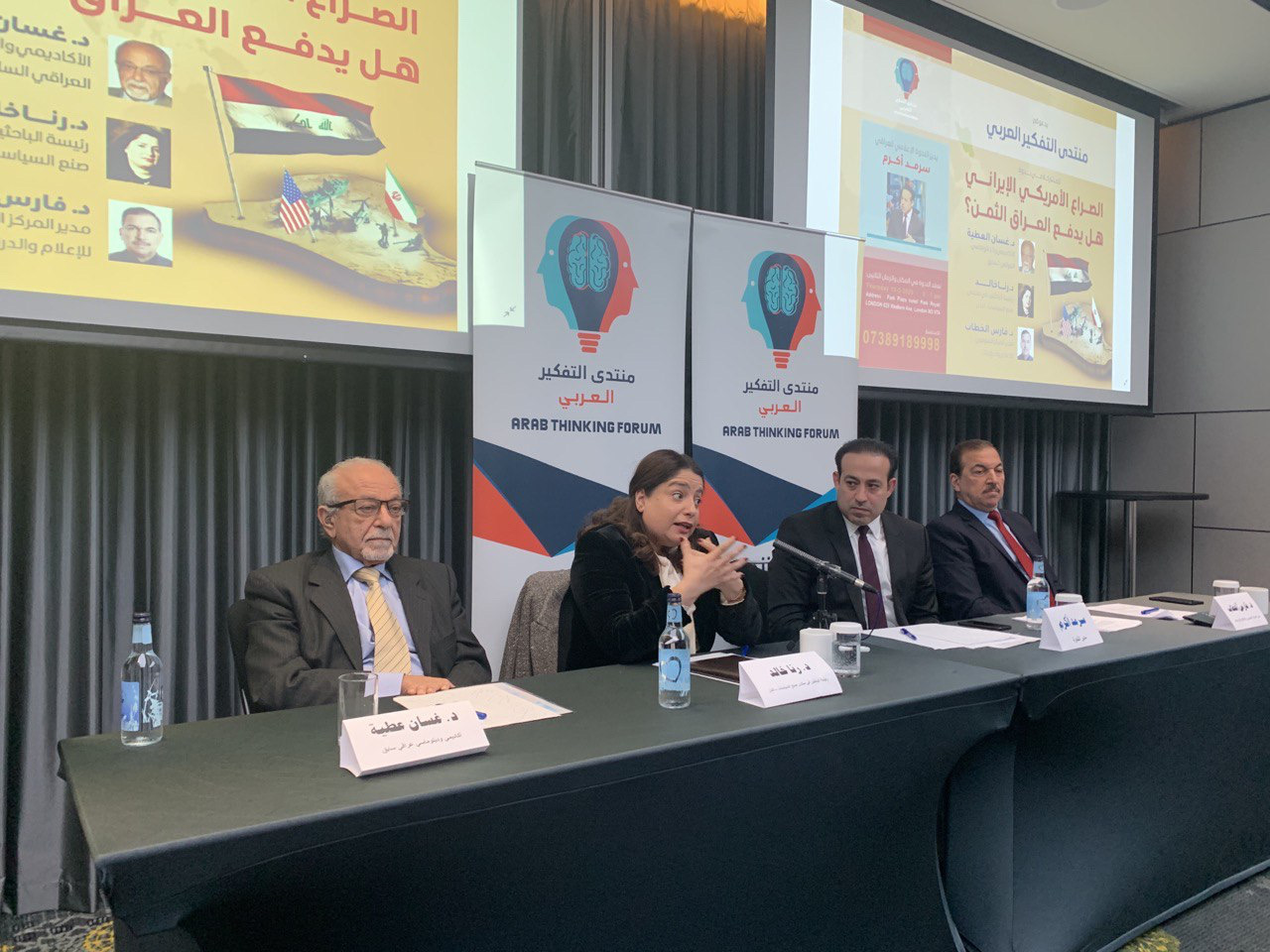
Dr Ghassan Atiyyah (left) on the Arab Thinking Forum panel in London, "The US–Iranian conflict: does Iraq pay the price?"